'/%3e%3cpath%20d='M3.3502%2033.6975C2.61887%2033.6954%201.90823%2033.4722%201.32613%2033.0616C0.744024%2032.651%200.322241%2032.0756%200.124792%2031.4225C-0.0726576%2030.7695%20-0.0349965%2030.0745%200.232065%2029.4432C0.499127%2028.8118%200.981008%2028.2784%201.60457%2027.924C11.0207%2022.6164%2016.6379%2013.3609%2016.6379%203.15736C16.6379%202.33085%2016.9919%201.5382%2017.6221%200.95377C18.2523%200.369343%2019.1071%200.0410156%2019.9983%200.0410156C20.8895%200.0410156%2021.7442%200.369343%2022.3744%200.95377C23.0046%201.5382%2023.3587%202.33085%2023.3587%203.15736C23.3621%209.20494%2021.6828%2015.151%2018.4831%2020.4206C15.2835%2025.6902%2010.6718%2030.1051%205.09407%2033.2382C4.56979%2033.538%203.96611%2033.697%203.3502%2033.6975Z'%20fill='url(%23paint1_linear_4173_2804)'/%3e%3cpath%20d='M3.37413%2033.8365C2.62904%2033.8342%201.90579%2033.6001%201.31757%2033.1709C0.729357%2032.7416%200.309359%2032.1415%200.123311%2031.4643C-0.0627366%2030.7871%20-0.00433834%2030.0712%200.289369%2029.4285C0.583076%2028.7858%201.09552%2028.2526%201.7465%2027.9124C7.35975%2025.0199%2013.6599%2023.5034%2020.0635%2023.5034C26.4672%2023.5034%2032.7673%2025.0199%2038.3805%2027.9124C39.1187%2028.3375%2039.6541%2029.0131%2039.8756%2029.799C40.097%2030.5848%2039.9875%2031.4205%2039.5697%2032.1325C39.1519%2032.8445%2038.458%2033.3782%2037.6321%2033.6227C36.8061%2033.8672%2035.9116%2033.8037%2035.1341%2033.4455C30.515%2031.0676%2025.3318%2029.821%2020.0635%2029.821C14.7952%2029.821%209.61197%2031.0676%204.99289%2033.4455C4.49742%2033.7027%203.94033%2033.8373%203.37413%2033.8365Z'%20fill='url(%23paint2_linear_4173_2804)'/%3e%3cdefs%3e%3clinearGradient%20id='paint0_linear_4173_2804'%20x1='37.6883'%20y1='32.1149'%20x2='22.6621'%20y2='18.8662'%20gradientUnits='userSpaceOnUse'%3e%3cstop%20stop-color='%235F56AA'/%3e%3cstop%20offset='1'%20stop-color='%23A591F8'/%3e%3c/linearGradient%3e%3clinearGradient%20id='paint1_linear_4173_2804'%20x1='20.6207'%20y1='0.869272'%20x2='5.04264'%20y2='30.9022'%20gradientUnits='userSpaceOnUse'%3e%3cstop%20stop-color='%235F56AA'/%3e%3cstop%20offset='1'%20stop-color='%23A591F8'/%3e%3c/linearGradient%3e%3clinearGradient%20id='paint2_linear_4173_2804'%20x1='-3.86862'%20y1='31.8979'%20x2='35.5667'%20y2='29.7262'%20gradientUnits='userSpaceOnUse'%3e%3cstop%20stop-color='%235F56AA'/%3e%3cstop%20offset='1'%20stop-color='%23A591F8'/%3e%3c/linearGradient%3e%3c/defs%3e%3c/svg%3e)
'%3e%3cpath%20d='M10.4901%202.23L5.50015%204.10001C4.35015%204.53001%203.41016%205.89%203.41016%207.12V14.55C3.41016%2015.73%204.19017%2017.28%205.14017%2017.99L9.44016%2021.2C10.8502%2022.26%2013.1701%2022.26%2014.5801%2021.2L18.8802%2017.99C19.8302%2017.28%2020.6101%2015.73%2020.6101%2014.55V7.12C20.6101%205.89%2019.6701%204.53001%2018.5201%204.10001L13.5302%202.23C12.6802%201.92%2011.3201%201.92%2010.4901%202.23Z'%20fill='%2363589B'/%3e%3c/g%3e%3cpath%20d='M11.9003%2011.3C11.9203%2011.3%2011.9403%2011.3%2011.9603%2011.3H11.9803H12.0003C13.1503%2011.26%2014.0503%2010.33%2014.0603%209.17C14.0603%207.99%2013.1003%207.03%2011.9203%207.03C10.7403%207.03%209.78027%207.99%209.78027%209.17C9.80027%2010.32%2010.7003%2011.26%2011.9003%2011.3Z'%20fill='%23A591F8'/%3e%3cpath%20d='M14.1902%2013.41C12.9802%2012.61%2011.0201%2012.61%209.80014%2013.41C9.24014%2013.79%208.91016%2014.33%208.91016%2014.89C8.91016%2015.46%209.23014%2015.98%209.80014%2016.36C10.4101%2016.76%2011.2001%2016.97%2011.9901%2016.97C12.7801%2016.97%2013.5801%2016.77%2014.1801%2016.36C14.7401%2015.98%2015.0702%2015.44%2015.0702%2014.88C15.0802%2014.31%2014.7602%2013.79%2014.1902%2013.41Z'%20fill='%23A591F8'/%3e%3cdefs%3e%3cfilter%20id='filter0_i_5606_1739'%20x='3.41016'%20y='1.9975'%20width='17.2002'%20height='23.9975'%20filterUnits='userSpaceOnUse'%20color-interpolation-filters='sRGB'%3e%3cfeFlood%20flood-opacity='0'%20result='BackgroundImageFix'/%3e%3cfeBlend%20mode='normal'%20in='SourceGraphic'%20in2='BackgroundImageFix'%20result='shape'/%3e%3cfeColorMatrix%20in='SourceAlpha'%20type='matrix'%20values='0%200%200%200%200%200%200%200%200%200%200%200%200%200%200%200%200%200%20127%200'%20result='hardAlpha'/%3e%3cfeOffset%20dy='4'/%3e%3cfeGaussianBlur%20stdDeviation='2'/%3e%3cfeComposite%20in2='hardAlpha'%20operator='arithmetic'%20k2='-1'%20k3='1'/%3e%3cfeColorMatrix%20type='matrix'%20values='0%200%200%200%200%200%200%200%200%200%200%200%200%200%200%200%200%200%200.25%200'/%3e%3cfeBlend%20mode='normal'%20in2='shape'%20result='effect1_innerShadow_5606_1739'/%3e%3c/filter%3e%3c/defs%3e%3c/svg%3e) Sign up
Sign up
In connection with publications mentioning Asocks in the context of an investigation by competent authorities, we consider it necessary to provide clarification and distinguish the actual operating model of the platform from incorrect generalizations.
Asocks is a commercial proxy platform and proxy marketplace that connects independent proxy infrastructure suppliers with customers who use proxies for lawful business purposes, including ad verification, marketing research, price monitoring, service availability testing, access to geographically distributed resources, and other legitimate use cases.
We do not support the use of proxies for unlawful purposes and expressly prohibit this in the Asocks Terms of Use.
The Asocks model is based on cooperation with independent suppliers. When onboarding suppliers, the company expects them to ensure the lawful origin of proxies, verify the quality of the infrastructure, comply with applicable law, the rules of the Android platform and app stores, as well as Asocks internal requirements. Hidden use of devices, connecting users without notice and consent, deceptive monetization, or supplying traffic with signs of device compromise contradict the platform’s requirements.
Following the publications, Asocks conducted an internal review of its suppliers and identified one of many counterparties whose actions, according to the information available, may have been inconsistent with the platform rules, the agreed arrangements, and applicable legal requirements.
With respect to the supplier mentioned in the publications, before entering into commercial cooperation Asocks reviewed the publicly available information about its operating model: the website, user-facing documents, product description, declared monetization model, user flow, and materials related to notifying end users.
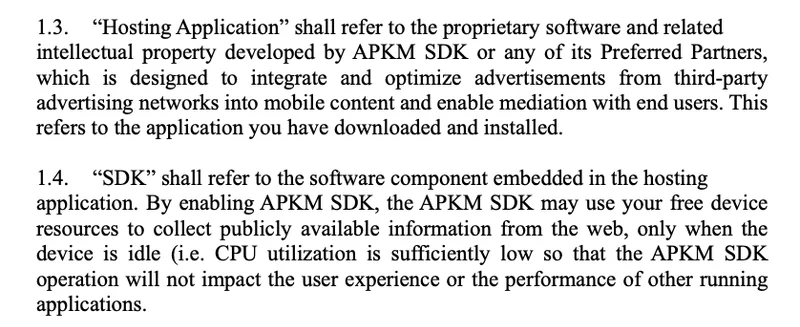
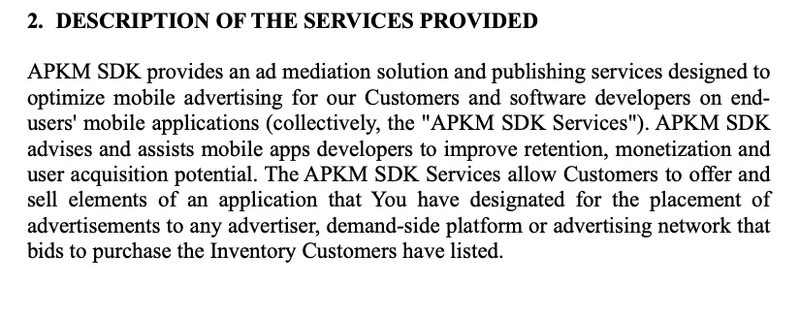
According to the declared model, the supplier’s service operated as a technology platform for mobile app monetization, not as a service that independently installed applications or software on users’ devices. The supplier provided developers with a monetization tool, while the applications themselves were created, published, and distributed by their authors and developers through the relevant platforms.
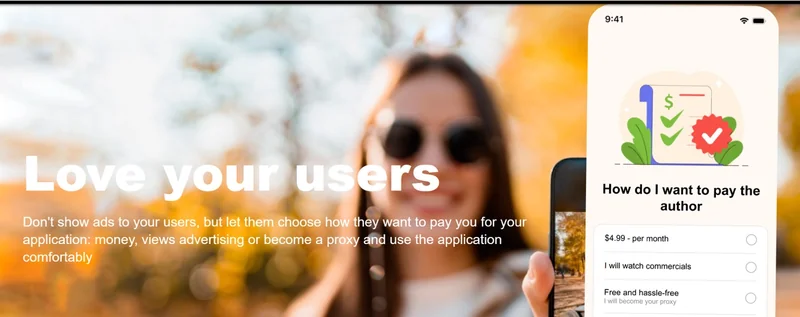
The model reviewed by Asocks before the start of cooperation worked as follows: the app author integrated an SDK component as an alternative monetization tool; the user received notice of the possible app usage model and chose between payment, viewing ads, or allowing the device to be used as a proxy node. After that, the application could use the device’s free resources within the declared model, without degrading the user experience, interfering with the operation of other applications, or accessing confidential information or other user data beyond the declared model.
The supplier’s platform provided that the participation of the end user had to be transparent, voluntary, and based on the user’s consent. The direct mechanism for notifying the user, providing a choice, and obtaining informed consent had to be implemented at the level of the app author and the app’s user interface, or through the built-in tool of the SDK component at the start of use, if the app author chose not to notify the user independently and instead delegated this function to the platform’s tool.
This approach does not contradict the basic logic of European Union law regarding technical intermediary services and the processing of user data. Regulation (EU) 2022/2065 on a Single Market for Digital Services, also known as the Digital Services Act / DSA, refers to “mere conduit” services as intermediary services related to the transmission of information in a communication network or the provision of access to a communication network. Regulation (EU) 2016/679, also known as the General Data Protection Regulation / GDPR, establishes the principles of lawfulness, transparency, data minimization, and the existence of a legal basis for processing. Directive 2002/58/EC concerning privacy and electronic communications / ePrivacy Directive provides that access to information on a user’s device or storage of information on such device should be accompanied by clear information and user consent, except for specific technical cases provided by law.
At the time of review, the presented model did not appear to be a botnet, malicious infrastructure, or hidden use of devices. On the contrary, it suggested a transparent monetization path: the user receives free access to the application as an alternative to payment or viewing ads, the app author receives an additional source of revenue, and the supplier provides the technology platform for such monetization.
Asocks does not consider such a model, in and of itself, to be harmful where it is implemented transparently and with proper user consent. Under this model, the user receives free access to the application in exchange for voluntarily allowing limited use of the device’s traffic, while the developer receives an additional monetization channel without having to overload the application with advertising or make it fully paid.
If individual developers independently distributed applications in violation of platform requirements, with insufficient disclosure, without proper user consent, or with other violations, such conduct contradicted the supplier’s requirements, the terms of use of its platform, and the rules of the Android platform or app stores. The supplier’s platform did not distribute any applications independently, did not install them on users’ devices, and only provided a tool to app authors.
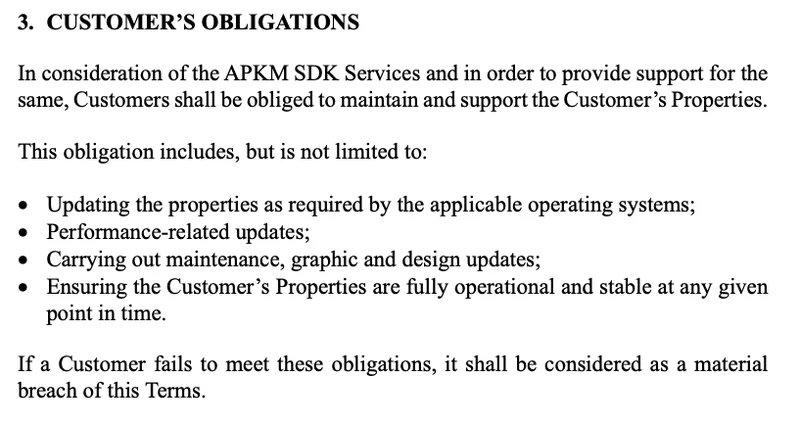
According to the supplier’s documents, app authors and platform customers were independently responsible for their applications, their functionality, content, publication, correctness of user interaction, and compliance with applicable rules.
At the time of review, Asocks had no grounds to believe that the supplier’s declared model violated the rules of the Android platform or app stores, including Google Play and similar platforms. On the contrary, the declared model assumed that the user had to be notified of the relevant functionality and had to provide consent before the device participated in such model. This approach is consistent with the logic of platform rules, according to which functions that go beyond the user’s reasonable expectations must be clearly disclosed to the user before they are used.
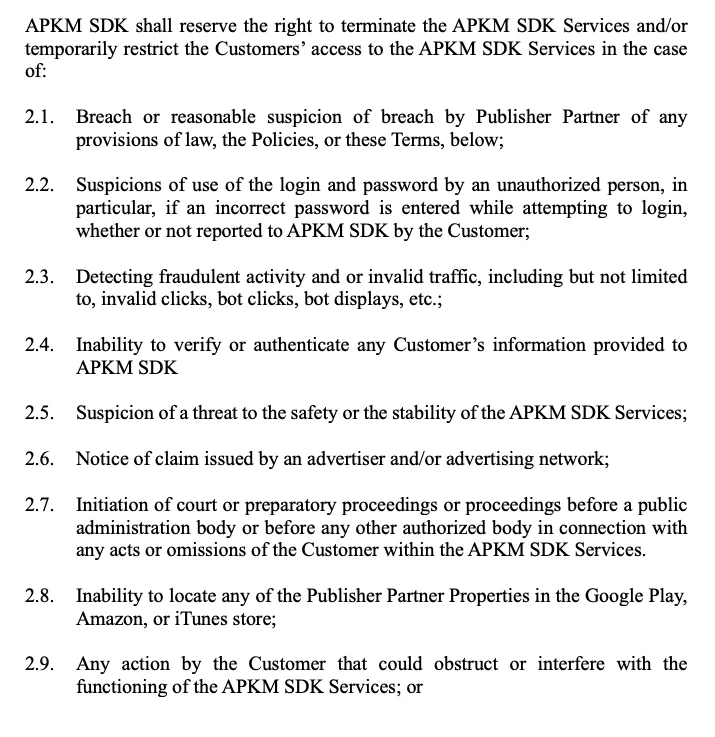
The Asocks Terms of Use expressly prohibit the use of the service or the supply of proxies in violation of the law. Asocks reserves the right to restrict, block, or terminate access to the service if violations, suspicious activity, or risks to users, customers, partners, or the company’s reputation are identified.
The mention of one third-party supplier in the context of an investigation does not mean that the entire Asocks platform is a botnet or operates in violation of the law. Such statements are incorrect, overly broad, and do not reflect the actual operating model of the service.
At the same time, Asocks does not dispute the investigation and does not question the actions of competent authorities aimed at protecting users and combating cybercrime.
Following the publications and additional information about possible violations by one of the third-party suppliers, Asocks conducted an internal review and decided to terminate any existing commercial relationship with that supplier and related supply channels.
Asocks considers it unfounded to attribute possible violations by individual app authors to the supplier’s entire platform, since the supplier did not independently distribute applications, did not install software on users’ devices, and provided exclusively a technological tool for monetization. At the same time, considering that this supplier is not material or critical to Asocks infrastructure, the company decided not to enter into a public confrontation on this matter and to terminate any existing commercial relationship with the supplier and related supply channels.